
The Hardest Sale A Founder Will Make
Recruiting great early employees is harder than landing customers or investors

Recruiting great talent to an early-stage startup might be the hardest sale you'll ever make as a founder.
You're asking someone to leave a stable job, turn down six, seven, eight, or (and I can’t believe I'm saying this) even nine figure compensation packages to join your company where the future is uncertain, the equity might never be worth anything, and the amount of money you’ve raised might be WAY less than they would make in a year.
This isn't a sale you can show up to unprepared and shoot from the hip to close. This is convincing someone to bet their career on you and your vision. This is convincing someone to go to their spouse excited about why taking a risk joining an early-stage startup where they'll make less money, work longer hours, and generally be more stressed makes sense.
And like I have talked about before, you can't do that effectively if you're rushing through the process or treating recruiting as an afterthought.
The Stakes Are Higher Than You Think
When you're selling to a customer, the worst case scenario is they say no and you move on to the next prospect. When you're pitching an investor, a rejection means you just keep fundraising.
But when you're recruiting an early employee, this person is critical to helping scale your company and you're asking them to make a life-altering decision. The prospective employee sitting across from you isn't evaluating whether your product will help drive efficiency within their organization, or whether you have a sound go-to-market strategy. They're deciding whether you're worth betting their livelihood on. And it’s not just them you need to convince.
Sell Their Support System
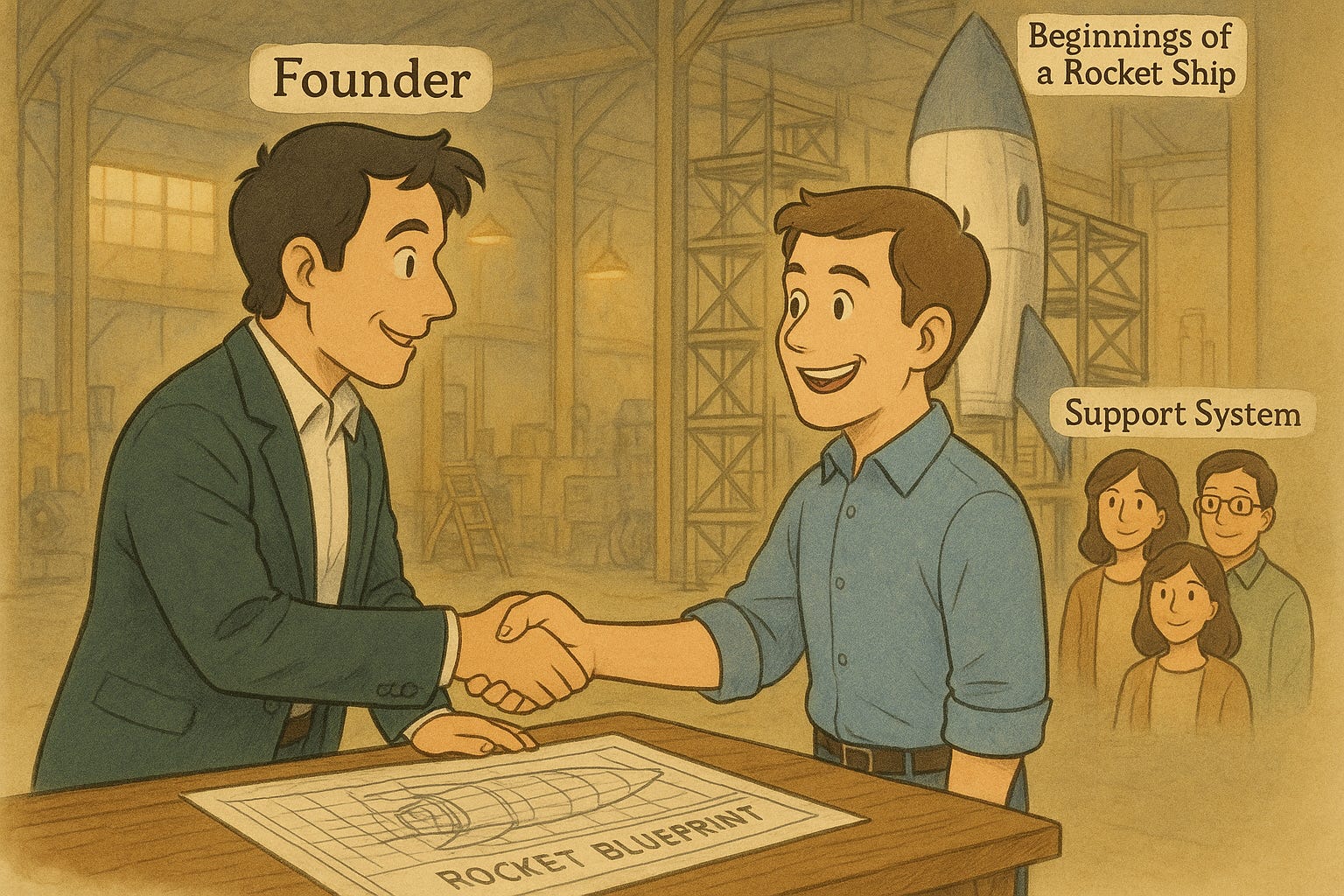
One of the most important lessons I learned during my time at Poynt and Legion was this: you're not just recruiting the employee, you're recruiting their entire support system. That could be their partner/spouse. Their parents. Their roommate. Why? Because when your early engineer is working late nights to fix a critical bug before the biggest demo in company history, their partner is handling dinner and bedtime alone. When your head of sales is traveling constantly to close early deals, their family is adjusting their schedule to accommodate the demands of an unproven startup.
And when your star hire has a bad day (and trust me, they will have bad days) they will vent. If the support system isn't brought in to the fold and bought in on the opportunity, and instead of joining your company wanted their person to take that higher paying FAANG job with better benefits and more time off, it’s almost guaranteed that will be brought up. And you can’t afford to have grass is greener thoughts of less work, more pay, and happier family life rattling around in your key hire's head.
So the best piece of advice I can give (and founders that work with me will have heard this before) is make sure you’re selling the person or people behind your prospective hire as well. Take their spouse to dinner. Find out what they like. Send a gift for the whole family when you’ve gotten to the offer stage and you're trying to close. It will make a difference, because you can bet most others aren’t.
One portfolio company of ours was recruiting an early engineer to their team. He had competitive offers, and they really wanted to win but couldn’t match on compensation. However, they had learned during their conversations with the candidate that his partner happened to like the ballet, and they were visiting New York that coming weekend. The founders bought the candidate and his partner tickets to a show and had a bottle of champagne waiting for them at their hotel. The candidate signed.
Unsung Heroes of Startups
I have long said that early employees are the unsung heroes of startups (so much so that my co-founder and I started a podcast called Brick by Brick to share some of these amazing stories). They are taking on a huge amount of risk without nearly as much upside, and are the ones who turn the founder vision into reality. They're the ones who will work weekends, take pay cuts, and believe in your mission when the rest of the world is skeptical.
As I’ve said before, the best founders I've seen succeed long-term are the ones who treat hiring as just as critical as product development or customer acquisition. They understand that every great hire makes the next great hire easier, and every bad hire (or missed hire) sets them back months.
So spend the time. Make the calls. Meet the families. Do whatever it takes to convince the right people to join you on the journey. It will be worth it.
This post was prompted both by a number of conversations I’ve had over the years about recruiting early teammates, as well as this post on X by Sanket Shah. Text included in full below:
Wife sent me this text today (I had requested her to tell me about this a couple of days back) and I think everyone can see it:
The Founder’s Wife — by someone who lives the role, silently and fully
When I married him, I knew I wasn’t signing up for a conventional life. He wasn’t the 9-to-5 kind. He was a dreamer. A doer. An entrepreneur with stars in his eyes and a mission in his heart. I was drawn to his fire — the way he spoke about solving problems, building for the future, changing the world. And I knew, in my gut, that loving him would be anything but ordinary.
But what I didn’t fully grasp was how invisible I might feel in the process.
Being married to a founder isn’t like any other marriage. It’s being constantly surrounded by uncertainty, silent tension, and the ever-present hum of a startup in motion. Wins were celebrated publicly — by investors, the team, the world. Losses, however, came home. And they lived with us. On the dining table. In the late-night silences. In the furrowed brows and distracted nods.
I became an uncredited co-traveller on his journey. I carried the weight of his setbacks, absorbed the stress he couldn’t voice, and learned to find pride in a kind of sacrifice that no one really talks about. My emotions, my worries, my longings — they always felt smaller compared to what he was building. So, I minimized them. Quietly.
We never really planned holidays. Life didn’t work like that. Dates became strategy calls. Long drives turned into brainstorming sessions. I’d sit next to him, craving connection — and he’d drift off mid-conversation, lost in thought, deep in the world he was building.
And yet, I stayed. Not out of obligation, but out of belief — in him, in us, in the dream that wasn’t mine but somehow became part of my identity. There’s a constant tug-of-war inside me — to be seen more, heard more — but also to give him the space he needs to fly.
I may not be on the cap table or the pitch deck. But I’m always there — in the quiet corners, the late-night meals, the missed anniversaries, the reassuring nods, the held-back tears. I am his sounding board, his safe space, and his loudest cheerleader.
Because sometimes, love means finding comfort in the background, knowing you’re part of a story far greater than just you.
I believe the sentiment expressed holds true for early employees as well.
This families-focus can be the only way early on. Great lost, thanks.