
FDE Should Mean Forward Deployed Executive
What real customer partnership actually looks like

A founder in our portfolio recently told me about a six-figure contract that caught me off guard. The customer wasn’t paying for the company’s software. They weren’t paying for a future product either.
They were paying for him.
They wanted him embedded as a fractional executive for a few months to help shape their AI and data strategy. Not advising from the sidelines, but in the room, helping drive decisions across the organization.
I’ve been chewing on the implications.
The Origins of FDE
Forward Deployed Engineers were pioneered by Palantir: instead of throwing software over the wall and hoping for adoption, you put engineers on the ground who understand the customer’s problems and can bridge the gap between what the product does and what the customer needs.
It’s been copied across the industry. And it works.
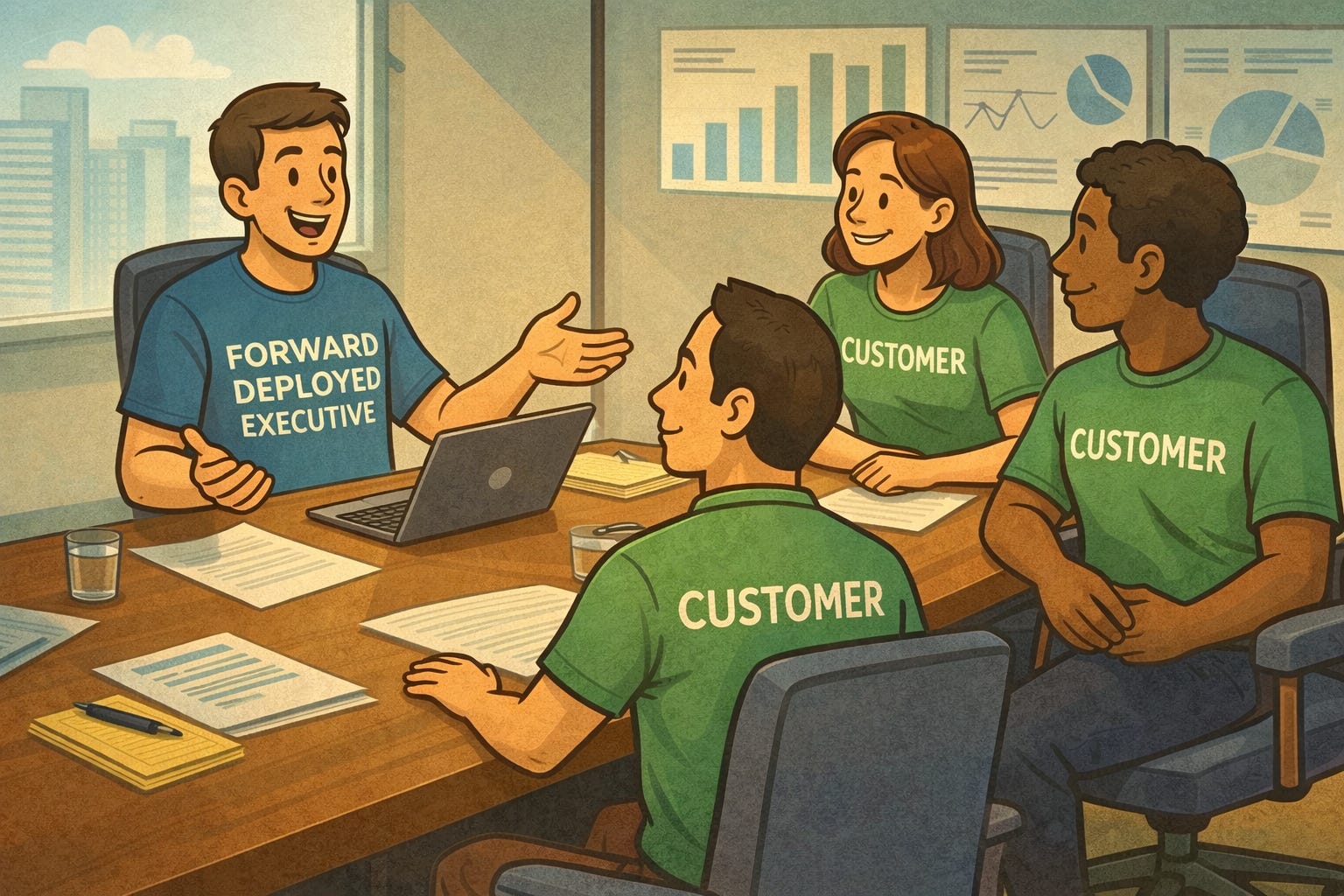
But I wonder if we’ve been thinking about the acronym too narrowly. What if FDE stood for Forward Deployed Executive?
In most organizations, especially smaller orgs outside of the tech bubble, there’s no single person who owns AI or data strategy. The most senior technical person is an IT leader, who most people associate with keeping systems running (networking, devices, security). They’re essential, but focused on infrastructure, not transformation. They’re not thinking about customer data as a source of strategic leverage, or how AI could reshape operations or unlock new revenue streams. That’s simply not the remit.
So when these organizations decide they need to “do something with AI,” there isn’t a natural person to lead the charge.
That gap can become a founder’s opportunity.
What “True Partner” Actually Means
If you can fill the leadership vacuum within a customer’s organization, you become something more than a vendor. Customers start treating you (and hopefully your team) as an extension of their own.
And when you’re embedded that deeply, you see their problems firsthand. You understand the constraints, the politics, the real blockers that never make it into a requirements doc. That knowledge flows directly into your roadmap. A better product creates more value. More value builds trust. Trust pulls you in deeper. And the flywheel turns.
The Evolution of FDE
Every founder talks about wanting to be a “true partner” to their customers. It’s almost a throwaway line at this point.
The vision in most folks’ heads of an FDE is someone young, scrappy, who can be thrown into uncomfortable situations. But the trade-off is that they are excellent at mapping out the minutiae, yet may not be a credible executive partner to the client. You make up for that by having lots of FDEs on-site.
But maybe a different bar has been set: your customer is willing to pay for your judgment, not just your product, and give you a seat at the table where decisions get made. This also takes advantage of more seasoned operators who can bring something different to the table. Less “I will grind through anything to make this work”, more “I’ve seen this before and have well formed opinions you trust.”
I’m not sure how many customer relationships can reach that level, but it’s worth asking which ones are closest, and what it would take to get there.
FDE. Same acronym. Different meaning. Or maybe FDX?
Thank you to Daniel S. for feedback on this post.
Love this post here Rishi! As some who has been an SE for 3 years now, what I find interesting is how deeper the relationship is with the end customer in the role of a FDE. Technical conversations become a daily occurrence with diligence and clarity on providing/creating a solution to the end customer. My concern is will now moving forward with there more specialized FDE’s or will FDEs work more alongside PM and technical teams to provide/create tailored solutions for these real time problems that are being conversed with the upper table of management? If so then, time to market and GTM will be very important.