
My Year in Books - 2025
Turning the page on another year
Happy New Year! As we begin 2026, I trust you have found time to rest and recharge with family and friends over the last few days. I hope the coming year brings you happiness, good health, and exceeds all your expectations.
2025 in the books, fifteen books completed during the year. This was a year where golf made a triumphant return to my life and to my reading list with a number of books that explored both the technical and philosophical sides of the game. I also made a conscious decision to read less non-fiction this year, though I realized I could still use more fiction recommendations (especially in the sci-fi realm after Project Hail Mary blew me away).
As always, below is the list of fifteen books from 2025 with quick thoughts on each. As I pull together my reading list for 2026, please click the link below and send me your book recommendations!
And for my past years’ reading lists, click here.
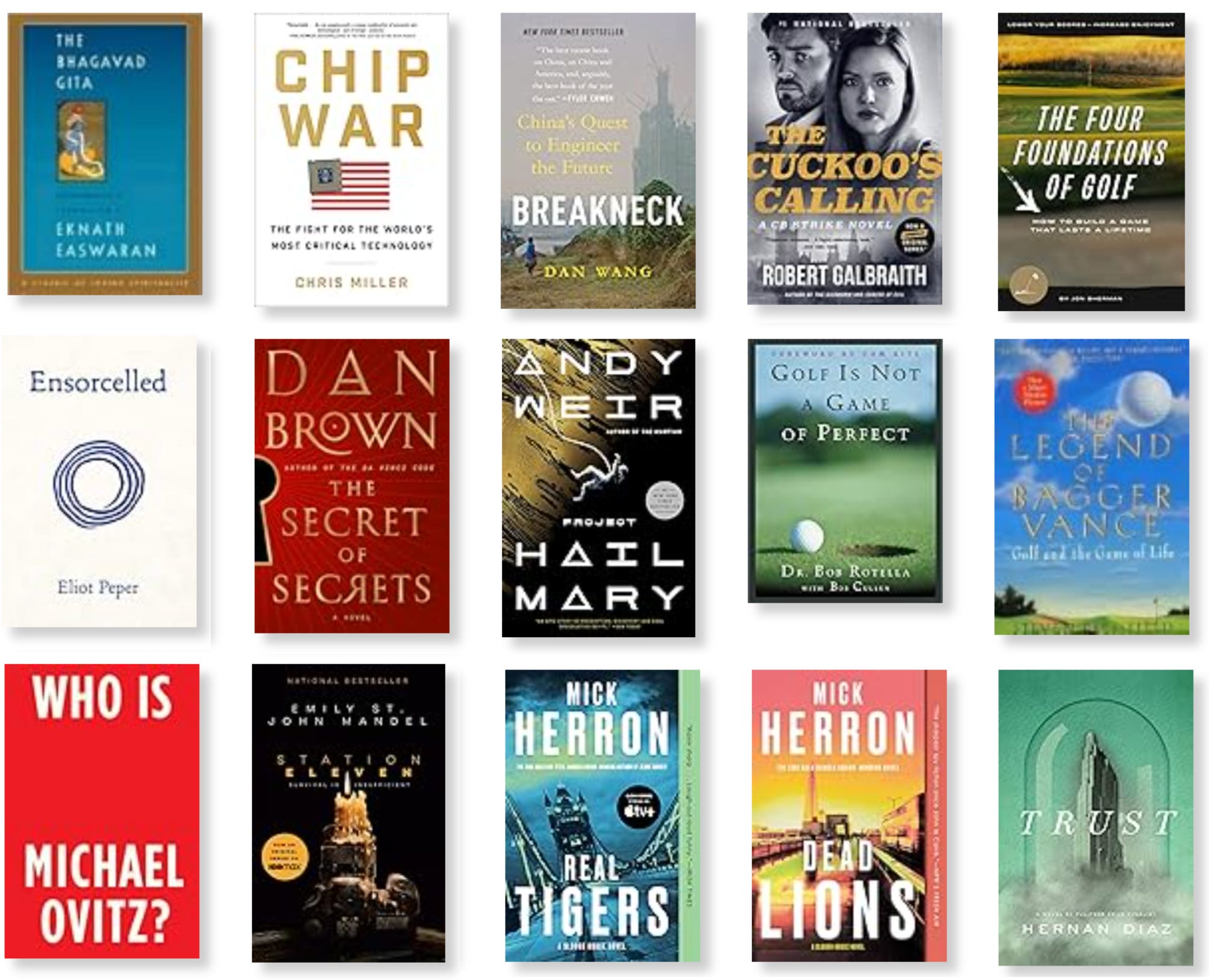
Note: * indicates a strong recommendation
Fiction
Project Hail Mary by Andy Weir*
One of my favorite reads of the year, Project Hail Mary exceeded all expectations. From the author of The Martian, the story of Ryland Grace waking up on a spaceship with no memory, tasked with saving humanity, is equal parts scientifically fascinating and emotionally gripping. The combination of hard science with deep humanity and humor with existential stakes made this an absolute must-read. And I’m excited for the movie coming this year!
Station Eleven by Emily St. John Mandel*
A post-apocalyptic novel that feels less about the collapse and more about what endures. Set in the aftermath of a devastating flu pandemic, the story follows traveling symphony performing Shakespeare twenty years after. Mandel weaves together multiple timelines to explore art, memory, and survival. The story’s central questions focus on what matters when civilization falls and answers that beauty, art, and human connection matter more than ever. This one stayed with me long after I finished it, a great read.
Ensorcelled by Eliot Peper
More of a novella, Ensorcelled is described as a “campfire fable for the digital age” that asks readers to reconsider the true meaning of magic. Set in the near future, the novella follows a teenage gamer, Tam, who is forced by his family to trade his highly anticipated game launch for a tech-free camping trip. Here, Tam discovers a deeper, more demanding kind of “magic” in the wilderness: the art of being fully present. A great exploration of the interplay between a digital life and the raw, essential rewards of the physical world. A great, quick read.
The Cuckoo’s Calling by Robert Galbraith
Robert Galbraith is better known as J.K. Rowling. This first foray into detective fiction introduces us to Cormoran Strike, a war veteran turned private investigator who is tasked with looking into the death of a supermodel. The story has classic detective novel beats, but Rowling’s character work elevates it beyond typical genre fare. Strike is wonderfully flawed and thoroughly engaging. A solid detective story that will certainly have me continue with the series in 2026.
Dead Lions by Mick Herron
I started reading Slow Horses series last year and thoroughly enjoyed continuing it in 2025. The second installment finds the disgraced MI5 agents investigating a Cold War era sleeper agent. Herron’s plotting is as intricate as ever, with threads that seem disconnected slowly weaving into a satisfying whole. The flashbacks to Cold War spy craft provide interesting contrast to the bureaucratic dysfunction of modern intelligence work. Another excellent entry in a series that keeps getting better.
Real Tigers by Mick Herron
Continuing my journey through the Slow Horses series, Real Tigers delivers more of Herron’s trademark wit and intricate plotting. The “slow horses” find themselves dealing with a kidnapping that hits uncomfortably close to home. Herron’s ability to blend espionage thriller mechanics with dark humor and genuine pathos keeps this series fresh. The dialogue is sharp, the plot twists satisfying, and Jackson Lamb remains one of the most entertaining characters in modern spy fiction.
The Secret of Secrets by Dan Brown
As my friends know, I love me a Dan Brown book. Call it a vice, call it a love of mystery coupled with ancient symbols and secrets, it doesn’t matter. Dan Brown returns with another Robert Langdon adventure, this time involving ancient secrets and modern conspiracies. It hits many of the familiar beats (symbology, historical mysteries, breathless pacing) and is an entertaining page-turner that doesn’t demand too much. Perfect airplane reading (which I definitely needed this year) that keeps you engaged without requiring deep investment.
Trust by Hernan Diaz
A novel told in four nested narratives, each revealing new layers of truth about a wealthy financier couple in 1920s New York. Diaz’s structure is ambitious, moving from novel to memoir to autobiography, and forces you to question everything you’ve read. It’s a meditation on truth, power, and who gets to write history. The writing is elegant, the construction ingenious, and the questions it raises about narrative reliability linger long after the final page.
The Legend of Bagger Vance: A Novel of Golf and the Game of Life by Steven Pressfield
The Legend of Bagger Vance is a perfect meditation on golf as metaphor for finding one’s authentic self. Set in Savannah during the Depression, the story of Rannulph Junah’s return to golf with the help of the mysterious caddie Bagger Vance is less about technique and more about surrender, presence, and the search for one’s “Authentic Swing.” Vance’s wisdom about letting go of the ego, trusting the swing that already exists within you, and approaching the game with love rather than fear provided a philosophical framework that complemented the practical advice of Sherman and Rotella. It’s a quick, lyrical read that has lessons which extend well beyond 18 holes.
Non-Fiction
Chip War: The Fight for the World’s Most Critical Technology by Chris Miller*
This is essential reading for understanding the modern geopolitical landscape. Miller traces the history of the semiconductor industry from its origins to its current status as the most strategically important technology on Earth. The book brilliantly explains why chips matter, how they’re made, and why control over their production has become the central struggle between the United States and China. Dense with information but never dry, it’s a masterclass in making complex technical and geopolitical subjects accessible. Reading about the steep competition between the US and Japan in the 80s, I was struck by the similarities in the discourse and dialogue around today’s AI race, and the US and China. Chris Miller needs to write a follow-up to as eloquently explain what’s going on today with the chip fight in AI land!
Breakneck: China’s Quest to Engineer the Future by Dan Wang*
Dan Wang’s deep dive into China’s engineering-driven approach to development is fascinating and nuanced. Rather than viewing China exclusively through the lens of Beijing politics or American assumptions, Wang examines how the country’s focus on physical infrastructure and manufacturing has reshaped its economy and society - the lawyerly society vs the engineering society. He challenges conventional wisdom about innovation, showing how China’s emphasis on process knowledge and manufacturing excellence represents a fundamentally different model than Silicon Valley’s virtual economy. A solid read for anyone trying to understand U.S. - China competition and how the governing styles will influence the next 20 years of competition.
The Four Foundations of Golf: How to Build a Game That Lasts a Lifetime by Jon Sherman
Jon Sherman’s approach is refreshingly data-driven and practical. Rather than promising quick fixes or secret techniques, he focuses on sustainable improvement through smart strategy and realistic expectations. His emphasis on course management over swing perfection was helpful, and he focuses on the idea that you don’t need to hit perfect shots to score well, you just need to avoid big numbers. The book also does something rare in golf instruction: it acknowledges that most of us aren’t going to practice five hours a day, and builds a framework around that reality. If you’re looking to actually improve your scores rather than just your swing, this is the book.
Golf is Not a Game of Perfect by Bob Rotella
Bob Rotella’s classic is required reading for anyone serious about golf. The core message (that golf is primarily a mental game) isn’t new, but Rotella’s articulation of it is brilliant and, like Bagger Vance, has application beyond the game of golf. The book helped me understand that confidence isn’t something you’re born with, it’s something you cultivate through how you think about your game. His emphasis on staying in the present, accepting whatever swing you brought to the course that day, and focusing on targets rather than mechanics transformed how I approach each round and day to day challenges in general. The concept of the “unconsciously competent” golfer (someone who trusts their swing rather than thinking their way through it). This book pairs perfectly with Sherman’s strategic approach: Sherman tells you what to do, Rotella tells you how to think while doing it.
(Auto)Biographical:
Who Is Michael Ovitz? by Michael Ovitz*
This is an amazing look at a titan of industry through his own words. A brisk tour of how he turned CAA into Hollywood’s power center. Deal vignettes - Jurassic Park, NBA TV rights, corporate tie-ups - reveal his playbook: out-prepare rivals, surround talent with 360° service, and use psychology as leverage. A masterclass in deal-making, accumulating power, and a seemingly relentless drive, it is almost certain that Ovitz would have been successful at whatever he put his mind to. It is also a cautionary tale - the same control that fueled CAA’s rise doomed his short, infamous run at Disney. An entertaining read!
Spiritual/Philosophical:
The Bhagavad Gita translated by Stephen Mitchell*
I read the Gita this year for the first time. Admittedly, it required a new way of reading, stopping to pause and reflect on the dialogue between Krishna and Arjuna on the battlefield. It is ostensibly about duty and war, but the teachings are really about how to live, how to act without attachment to outcomes, how to find peace in the midst of chaos, how to reconcile action with spiritual understanding. I thought it was a wonderful translation, and worth reading giving the enduring nature of its message.
The Courage to Be Disliked by Ichiro Kishimi and Fumitake Koga
Presented as a dialogue between a philosopher and a cynical young man, this book introduces Adlerian psychology’s radical ideas about freedom, interpersonal relationships, and happiness. The core insight (that we are not determined by our past but by the meaning we assign to it) is liberating. The book’s emphasis on “separation of tasks” (distinguishing what is your responsibility from what belongs to others) and the idea that “freedom is being disliked by other people” challenged my thinking about approval-seeking and living authentically. Some of the ideas feel extreme, but I think that’s partly the point: they’re designed to shake you out of conventional thinking. A thought-provoking read that pairs well with the Gita’s teachings on detachment.
Quote I'm thinking about: "You have a right to your actions, but never to your actions' fruits. Act for the action's sake. And do not be attached to inaction." - The Bhagavad Gita
Gold, as always, Mr. Taps! Thank you for adding to my already horribly-crippling tsundoku! I return the favor with this list full of fact, fiction, and everything in between: https://www.tomwhitenoise.com/bookshelf