
The AI Land Grab: $34B Acquisition Offers and $1 Pricing
Why the math might make sense

Perplexity just offered $34.5 billion to buy Chrome from Google. That's almost double Perplexity's entire company valuation. For a browser.
Meanwhile, OpenAI and Anthropic are practically giving away their premium AI models to millions of government workers for $1 per agency, products that normally cost organizations hundreds of thousands or millions per month.
AI companies are doing genuinely unnatural things to capture users. And honestly, it's kind of beautiful to watch.
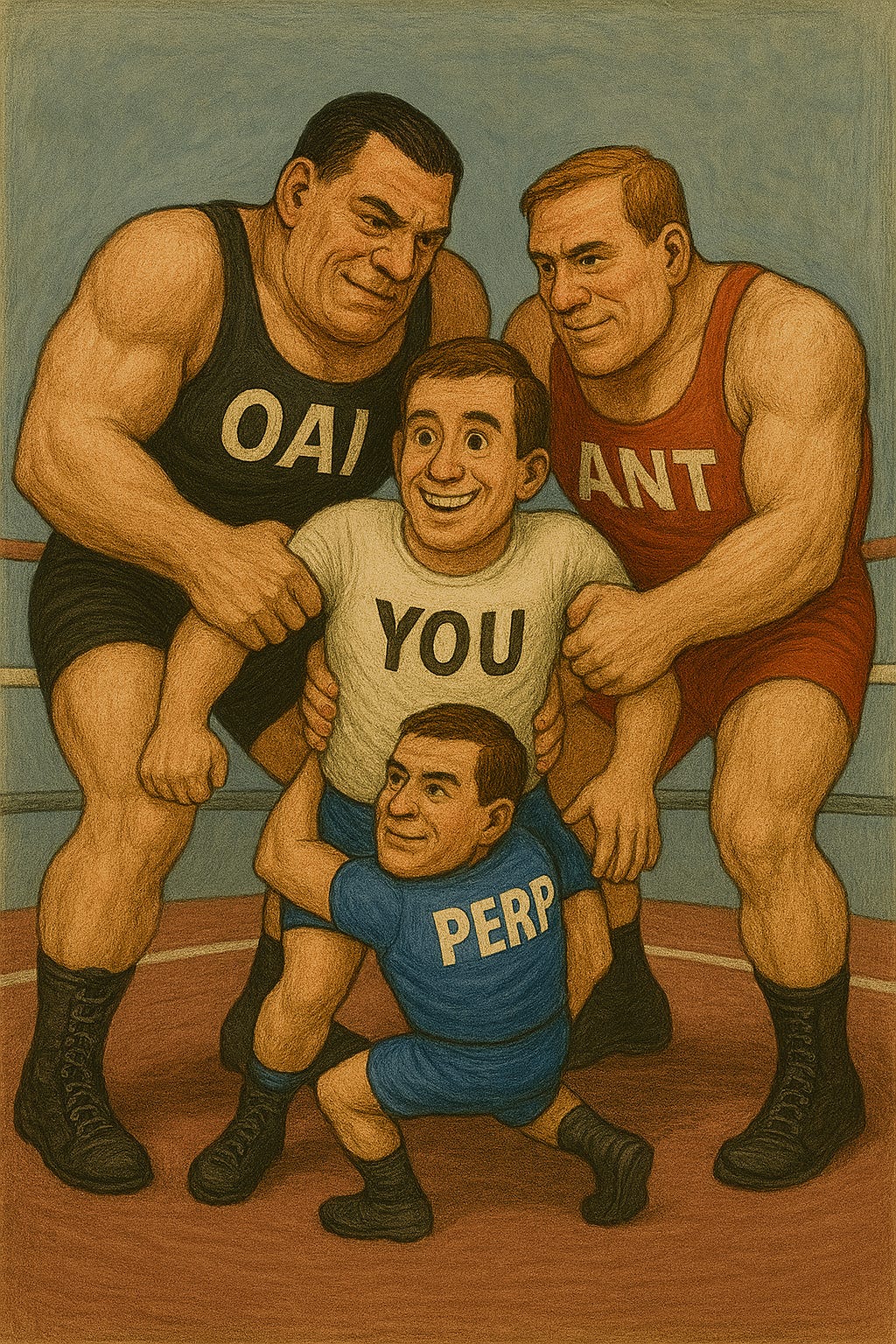
VC2C → VC2E
We've seen venture-funded land grabs before, but this feels different in scale and audacity. Remember when Uber and Lyft burned billions making rides artificially cheap? I like to call this the VC2C model: Venture Capital to Consumer. Derek Thompson later dubbed it the Millennial Lifestyle Subsidy, where companies went gross margin negative to train users to expect convenience at impossible prices. (For some great stories about that ride-sharing battle, check out my Brick by Brick interview with Amy Fox, Lyft's fifth employee.)
The AI wars are the same playbook, just for our cognitive work instead of our commute. And it's not just VC2C, it's VC2E - Venture Capital to Everyone.
In the last week:
OpenAI goes after 2.4 million federal workers with a basically free plan
Anthropic hits back, offering all three branches of government (3 million potential users) access for the same $1
Perplexity puts in an unsolicited bid of $34.5 billion to buy Chrome (3.5 billion potential users) Unlikely to happen, but damn!
Why the math “works”
These companies are making a bold bet: AI switching costs are going to be higher than your average software. Once ChatGPT knows your personal or business context or Claude becomes your coding partner, changing platforms means rebuilding trust and workflows. The bet is simple: get users hooked while you have infinite access to capital at eye-watering valuations, then raise prices once they're dependent on your specific workflow. Not dissimilar to the Uber/Lyft playbook, or why legal research and design software tools are free for law students and architecture student. They learn it in school and bring it to work.

But there's a catch. This is all contingent on how much it costs to run a model. And yes, model costs are dropping dramatically.

But as Ethan Ding points out, tokens are getting more expensive because "nobody wants yesterday's newspaper."
gpt-3.5 is 10x cheaper than it was. it's also as desirable as a flip phone at an iphone launch.
when a new model is released as the SOTA, 99% of the demand immediatlely shifts over to it. consumers expect this of their products as well.
So maybe the cost of AI won’t go down as much as we think?
Who benefits?
Premium AI capabilities that should cost thousands per month are essentially free. Investors are subsidizing our productivity just like they once subsidized our rides and food delivery. But this golden age won't last forever. The fight for AI mindshare is creating some of the most aggressive user acquisition strategies I've ever seen and once the wrestling match settles, the winners will have pricing power over users who can't imagine working any other way. And while further monetization may come in the form of ad-supported models or new usage limitations like we’ve seen Anthropic institute recently, where AI pricing nets out and the “business model of AI” is still a big unknown.
So, enjoy the investor-subsidized AI honeymoon while it lasts, because it’s not going to last forever.
VC2C is a great coinage. The Uber parallel runs deeper than most people realise. Uber lost 58 cents on every ride in 2018, burned a billion a year in China alone. The AI inference market is doing the same thing right now. I tracked what actually happened when three providers stopped pretending the maths worked and raised prices. The backlash was instant but pointed in the wrong direction: https://sulat.com/p/the-real-cost-of-cheap-ai-inference
So well said. Wrote about this: “What happens when the common man/woman can no longer afford the AI tools they’ve become addicted to?
Withdrawal. And in this case, withdrawal will feel like cognitive amputation.
It will feel, in short, like Flowers for Algernon or Common People in reverse: a society that handed out genius on a subscription plan—only to revoke it when the trial ends.
We trained the machines to think.
Then we let them think for us.
When the tab comes due, we may find we’ve forgotten how to pick up the pen.”
More: https://www.whitenoise.email/p/the-great-ai-bait-and-switch