
The AI Brush
When transformation and correction blur together

On Sunday, Citrini Research published a fictional thought experiment about AI-driven mass layoffs cascading into economic collapse. Software, payments, and delivery stocks cratered. (NB: worth reading this Citadel response)
On Thursday, Jack Dorsey announced Block is cutting 40% of its workforce, more than 4,000 people, because “intelligence tools have changed what it means to build and run a company.” Block surged in after-hours trading.
Both stories pointed to the same thing: AI replacing large swaths of the workforce. The fictional version caused panic. The real version caused a rally. That disconnect is worth sitting with.
A few things can be true at once
AI is genuinely changing how companies are built and operated. The capabilities are real, they’re compounding, and organizations will look meaningfully different because of them.
And *also*, Block had roughly 3,900 employees at the end of 2019, which ballooned past 12,500 in 2022. Layoffs have happened in 2023, early 2025, and again earlier this month.
So when the explanation for cutting nearly half the company is AI, it’s fair to ask: how much of this is the future arriving, and how much is the past catching up?
To his credit, Dorsey acknowledged that Block over-hired during COVID and that he “incorrectly built 2 separate company structures (Square & Cash App) rather than 1.” That’s an honest admission and an important one.
The answer at Block is that multiple things likely are happening at once. AI is genuinely enabling smaller teams to do more. The company grew too fast and made expensive bets at the peak. And maybe a hard reset is the only way to rewrite the playbooks for what comes next. All of those things can be true. But framing can turn the same set of facts into either a selloff or a surge.
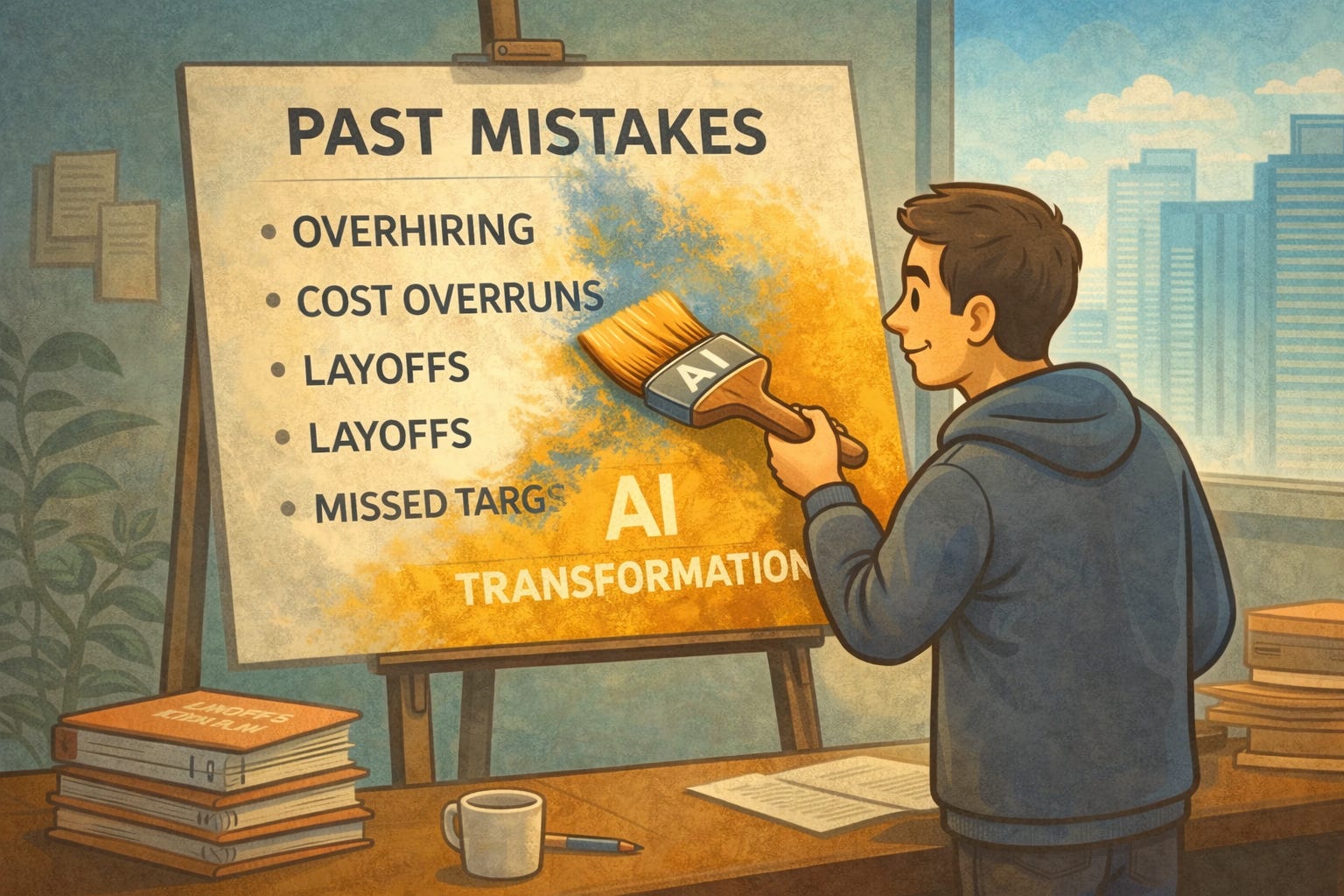
Enter the AI Brush
A brush can paint something new on a blank canvas. It can also cover up blotches and mistakes. AI has become a very convenient brush. That part isn’t new. Every cycle has a narrative that makes painful corrections feel strategic:
2001 → “dot-com reset”
2008 → “financial discipline”
2020 → “COVID realignment”
2025/2026 → “AI-native transformation”
When the dominant narrative is that AI is reshaping everything (and it is), it becomes easy to fit your company’s story into that narrative. Over-hired during COVID? That’s not a correction, that’s an AI-native reset. Multiple rounds of layoffs? Not a pattern, a transformation. The narrative is so powerful right now (and changing so quickly) that most will nod along because it matches what they’re already reading and hearing everywhere else. It’s a great way to reinforce a version of reality that may not be quite right.
As Wharton’s Ethan Mollick noted, given that effective AI tools are genuinely new, it’s difficult to believe that any organization has unlocked a sudden, firm-wide 50% productivity gain in under two years. That doesn’t mean AI isn’t a factor. It means it probably isn’t the only factor.
Markets are reinforcing the pattern
A fictional scenario about AI layoffs tanks stocks. An actual announcement of AI layoffs sends shares soaring. The fictional scenario implied collapsing demand. The real one implied expanding margins and operating leverage.
Dorsey himself said he thinks most companies will reach the same conclusion within a year. He might be right. This is going to ripple. Every CEO who watched Block’s stock surge 24% on a 40% headcount reduction is now looking in the mirror and asking themselves what their version of this announcement looks like. And the ones who are honest with themselves will separate what AI actually changes from what was already broken. But you’ll likely see everyone reach for the AI Brush.
So as more of these announcements land, it’s increasingly important to read past the headline and spend time deciphering what AI is genuinely changing and what is simply being rewritten under its banner. The answers are usually in the footnotes, not the press release.
Well-stated. In the coming months, AI’s heavy lacquer is going to cover very many managerial missteps. A lot of square holes will be stuffed by round pegs.