
Is $100M ARR the New Seed Milestone?
There's a new benchmark in town. What does that mean for your raise?

Two different analyses landed recently that together articulate the profound shift that is taking place in the venture ecosystem.
AI Bends the Growth Curve
Bessemer’s State of AI 2025 report looks at how quickly AI companies are scaling revenue and reveals the rise of what they call the “AI Supernova”. These are companies that, on average, get to $100M in ARR in just 18 months. To put that in perspective, the best cloud companies of the past decade needed nearly 7 years to reach the same milestone.
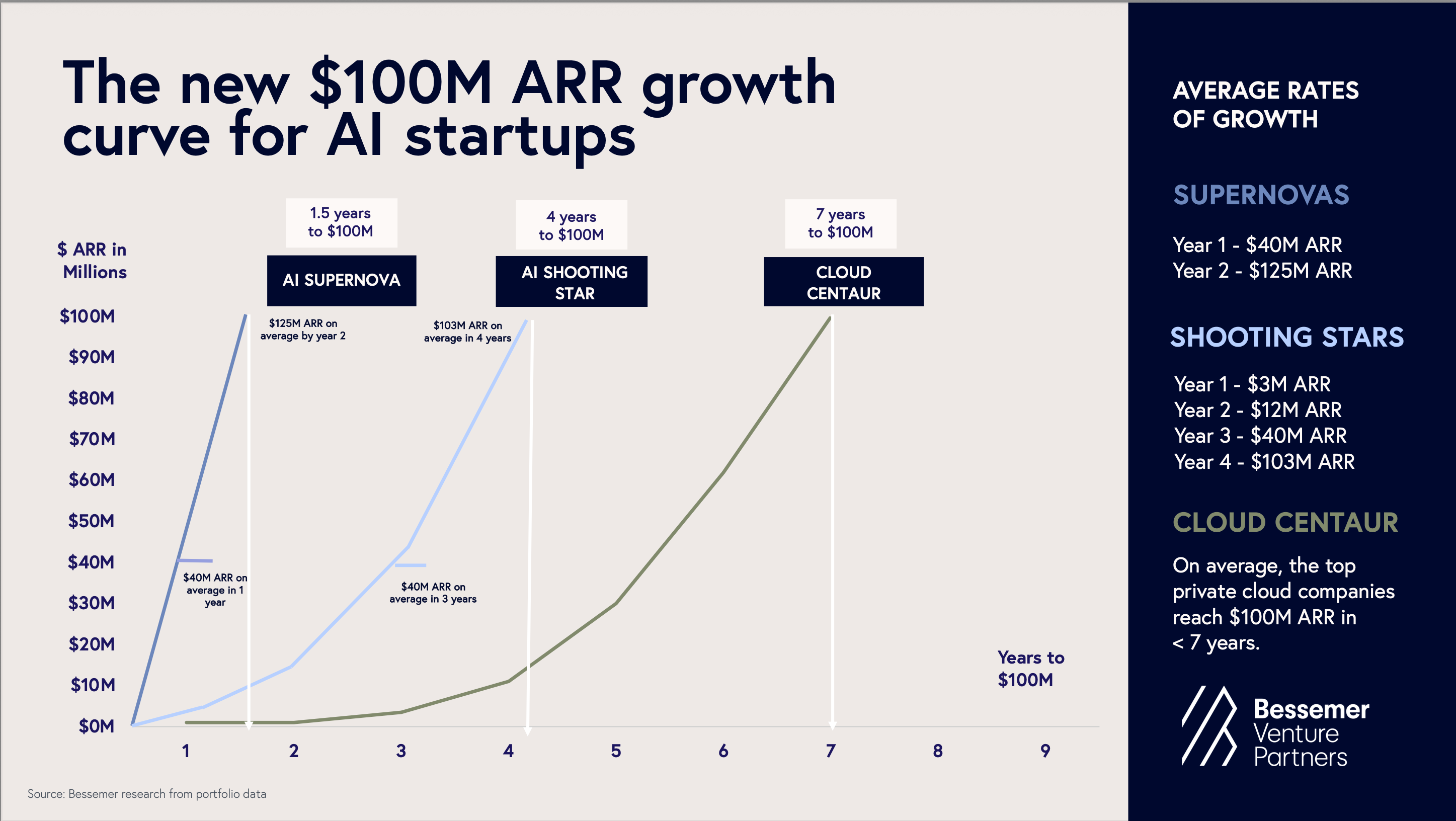
Supernovas aren’t “fake it till you make it” businesses. They’re winning customers and scaling real revenue just on a timeline that looks almost impossible by historical standards. These are names you know like OpenAI who have reportedly crossed $10B in ARR 3 years after launching ChatGPT. Or Anthropic who went $0 to $100M to $1B (and now have cleared $4B). Amazing feats of growth and scale.
Capital is Hunting Earlier
The speed of growth explains why mega funds are now steamrolling their way into the very early-stage investors as shown in the Sapphire Partners and OpenLP analysis into the most active investors at Seed and Series A. According to the data, in 2023 the most active “mega funds” accounted for over 10% of the 2,000 priced Seed rounds that were done, with Andreessen Horowitz having led or co-led 72 seed rounds (more than double the next closest fund). And while the data isn’t perfect as it only includes priced rounds, it is likely directionally correct and the message is a clear reflection of what I’m seeing and feeling as an investor in the market: mega funds are going earlier.
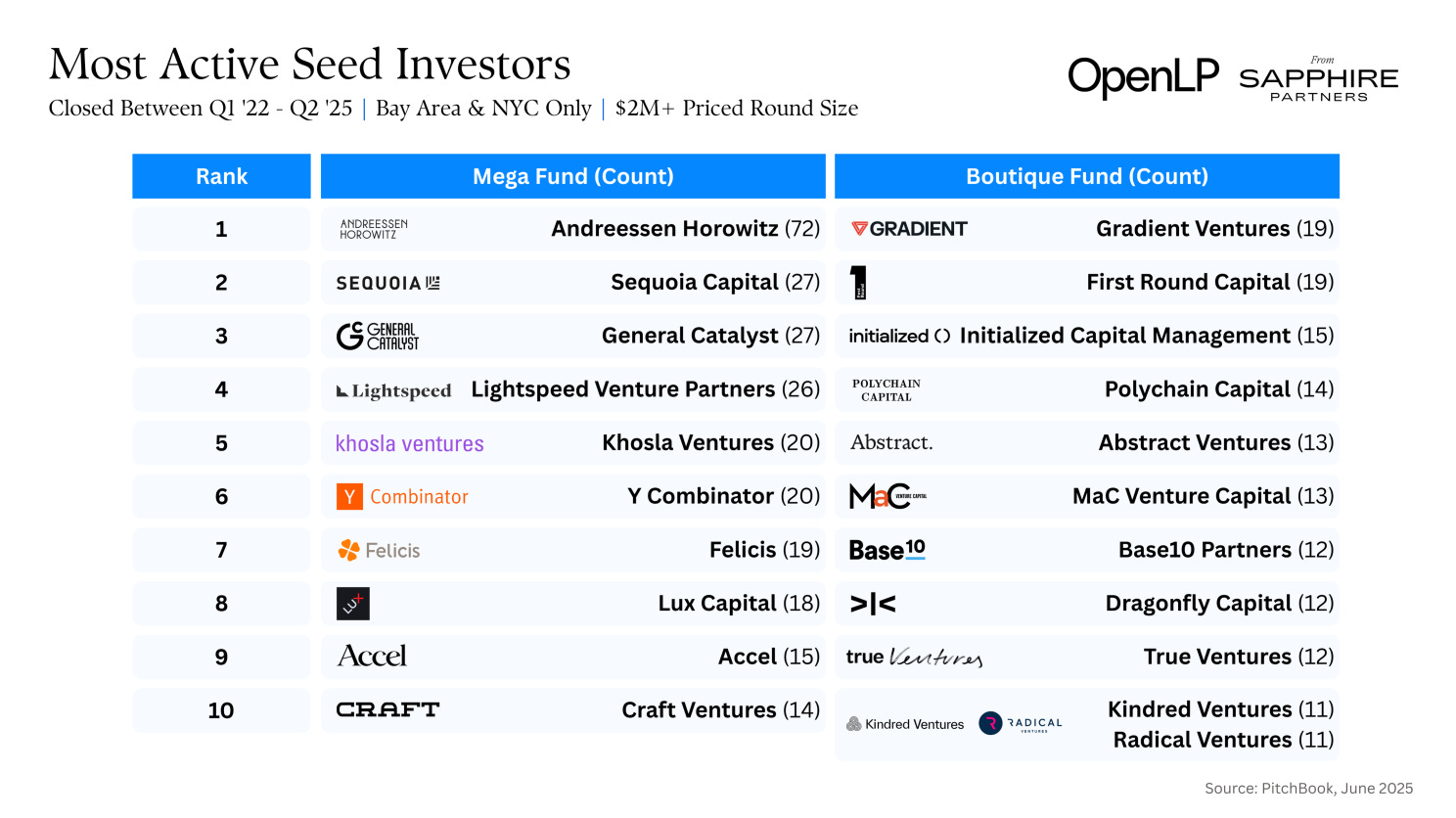
Why? Because everyone wants to catch Supernovas early and so they are willing to spread bets earlier just to have a chance at the handful that break out.
The New Benchmark is Set
Here’s the truth: most companies aren’t going to be Supernovas. But with Supernovas out there, even Shooting Stars (companies that get to $3M in revenue in year one) risk looking like under performers.
Now, if you’re not at $40M ARR in year one and on a path to get to $100M 18 months from earning your first dollar of revenue, do you have a bad business? No. But you ignore the fact that this level of speed and scale is top of mind for investors at your own peril. If you’re not meeting this bar, “Why not?” matters more than ever.
So when fundraising, you need to highlight what’s durable about the business, know the numbers and the plan, articulate how you will scale into building a massive business. And proactively address (if you’re not asked) why aren’t you growing as fast as [insert your favorite Supernova or Shooting Star company].
And when debating which funds to engage with, recognize that different funds are playing different games. When raising capital, make sure you’re talking to the right ones for you, your business, and the way you want to grow.
Finally, remember that getting to $100M “overnight” is not the only way to win. As my friends over at Scale Venture Partners have pointed out, there is no correlation between speed to $100M in revenue and eventual exit size. Granted, historical data and mostly non-AI, but it does underscore the importance of durability and defensibility. Ultimately, company building is a test of survival. Speed grabs headlines. Endurance builds companies.
So well said. I wrote about mega funds going earlier here: https://www.whitenoise.email/p/getting-down-in-the-dirt
"[I]nvestors ought to get dirty by tilling the soil and providing the right nutrients; it’s not about better seeds, but richer soil. By doing so, they increase their surface area for serendipity and success. To use another useful metaphor, this approach resembles a lopsided game of darts: it’s much easier and effective to win by making the dartboard larger instead of trying to hit an already-tiny bullseye."